Scope Creep: When a project grows before your very eyes

My first instructional design job could be the poster child for Scope Creep. What is scope creep you ask? These are changes or expansion in a project plan or project requirements after a project is underway (Technopedia, n.d.). Because I was new to the world of instructional design and had no clue about project management, my first experience took twice as long and cost more money than we had originally budgeted. While the end product was great, it was definitely not delivered on time or under budget.

It all started when we didn’t establish a realistic timeline. This project was an idea for a training class that a colleague and I thought would be a good idea based on a needs assessment we had conducted with several management teams. We sold this idea to our bosses and they loved the ‘idea’. We put together a rough draft of a project plan and then set it aside. When we were asked to add something to the class, we simply said, “sure” and did it.  We didn’t refer back the plan often and in fact saw the plan as more of a “work in progress” and therefore didn’t have a clear sense of what was in the scope or outside the scope. In fact, we changed the scope at will – we were probably the biggest culprits of scope creep.

It wasn’t until we were called into the Directors office to talk about our timeline and progress did we really grasp that we hadn’t done our due diligence. This was an, unfortunately, painful conversation, that served as a wake-up call.  It prompted me to admit that I had never run a project before and it has gotten bigger than either of us had anticipated. We tightened down the timeline, stopped making changes and got it accomplished. In this case, the scope creep was us. We just had to get out of our own way and get the job done.


References

What is scope creep? – Definition from Techopedia. (n.d.). Retrieved from https://www.techopedia.com/definition/24779/scope-creep

Tools of the Trade

When looking at Project Management software there are a lot of choices. These tools allow Project Managers (PM), stakeholders, Subject-Matter experts, and other project participants to participate in a project in a timely manner while allowing the PM to keep a close connection to the project timeline and deliverables.

One of the tools I have used in the past is Teamwork. Teamwork is a comprehensive tool that allows the user to have multiple inputs from many resources link those resources so they can collaborate together, and it integrates with many different tools such as Dropbox, Google Drive, and Quickbooks. They are not free but have a monthly fee that includes unlimited users – a nice feature if you have a larger group of individuals working on a project, or if the project teams are different from project to project.

Teamwork includes a wide variety of features including time tracking and billing, Gantt charts, sub-tasks, etc.). The tool also allows PM’s to include their clients in the tool. The integration with many different devices adds an additional level of flexibility. As a non-tech user, I found it easy to use and intuitive.

A free project management tool that I started using with my team is what I would call A “light-weight” tool – is Asana. For smaller projects and team tasks needing collaboration, this tool is ideal. Projects can be delegated to team members by task, sub-task, and due date. Work product can be uploaded and individuals from the work team can edit and comment on it. What I like about it the most is that I can put together a private to-do list and it integrates with my project task list as well. This program is easy to use and free. One drawback is that you cannot include outside team members (or clients). Asana does not include Gantt charts or billing options. It does, however, have a calendar feature and sends notifications when a task is due even telling you to update the timeline if the task is over the deadline. My team and I have stayed on track with projects and even been able to earn badges!


Alt, K. (2016, August 18). Best project management software: Wrike vs Basecamp vs Teamwork etc. Retrieved from https://www.werockyourweb.com/liquidplanner-vs-wrike-vs-basecamp-vs-teamwork-vs-zoho-vs-workfront-vs-clarizen/#teamwork/

Asana Reviews. (n.d.). Retrieved from https://www.g2crowd.com/products/asana/reviews

Email, phone or in-person?

Messages can mean many different things depending on the context. In the following email message, there are a few issues I can identify. See if you see the same thing.

email

I think the author of this email, Jane, starts off trying to make a connection with Mark and let him know she understands he is busy. Depending on the person, this may or may not work to help make a connection. For some people, it may seem to be pandering. For others, it may help them feel as though you understand how much they have on their plate.

The remainder of the email message is vague in regard to the request from Jane to Mark. Jane might miss the deadline if she doesn’t get Mark’s missing report soon. What is soon? Is it one hour? Is it one week? Which report is missing? Even if she has stated this in a previous email, it would behoove her to restate the exact report she needs in this request.

Her next appeal asks him to determine when he thinks he can send the data or report. Then she ends with an ambiguous final request to send the data in a separate email. Why?

If this was a voice mail message instead, would that make is clearer? It might. Tone of voice, emphasis, and cadence of the speech, can often help the listener determine intent (Chapman, 2012). It can also continue to emphasize the same issues that are included in the email. The tentative speech patterns can leave the listener with a lack of urgency (Kim, 2015) or even with the impression that giving her the data may be optional. Even though I believe this speaker would like the data immediately, the message seems more lackadaisical and hands the timeline back to the listener.

What about having this conversation in person? This may be better because the two individuals have the ability to read each other’s facial gestures and body language, while also listening to their tone of voice. If the speaker ends his or her sentences with an upward inflection, it can leave the listener with the impression that the speaker is unsure and lacks confidence. As Mehrabian’s research points out, 7% of what we convey is in the words we speak, 38% are the way the words are said, and 55% relates to the facial expressions. This is important when you are communicating and want to ensure your message is heard and equally important, understood.

As a project manager (PM), one should ensure their message is understood well no matter which communication tool is used. Checking in and confirming understanding are essential components for the PM to consider. The less we have to go on, the more likely there will be an opportunity for misunderstanding.

Chapman, A. (2012). Mehrabian’s communication research. Retrieved from http://www.businessballs.com/mehrabiancommunications.htm

Kim, M. (2015, November 6). I’m sorry, but may we discuss tentative speech? Retrieved from https://ww2.kqed.org/forum/2015/11/06/im-sorry-but-may-we-discuss-tentative-speech/


Lessons Learned

I am a contingency planner – with just about everything in my life. I love thinking through what could go wrong and then devising a plan on how I will handle that if or when it does. For some people, it stresses them out to do this, for me, I find immense comfort and pleasure in knowing I am prepared for just about everything. I pride myself on my ability to anticipate problems, hiccups, and potential roadblocks. This behavior often drives other team members a little crazy because I am often trying to think about what could go wrong so I can have a plan in place, just in case. This can be perceived as a bit of a buzz kill if people are enthusiastically imagining everything going perfectly. However, one such project/event I was responsible for did not turn out the way I had anticipated and planned. Here are the background and autopsy results from the event.

I was tasked with planning, organizing and running an awards luncheon for 250 managers from around the country. There were a few traditional requirements for the luncheon, including the CEO speaking to the group, physical awards for each award winner (there were 40) and a keynote speaker. I had a specific budget to work with that had been allocated prior to my assignment as the event planner, and it seemed ample for what I had in mind. I was responsible for everything from the planning the food, to the entertainment (the musician and speaker), to ordering the awards. I had one person assisting me, but she had never planned or even attended an event like this before.

The day of the event, everything seemed to be going well. The agenda was flowing well; no one was over their time limit. The food was great, participant’s food allergies were attended to, the music was beautiful, the CEO was funny and personable, the awards were the best anyone had seen and seemed more expensive than the budget should have allowed, and then came the keynote speaker. She was hailed as a corporate storyteller. She had been recommended to me. In all my planning, I hadn’t had time to talk with her in detail. I figured since she had come so highly recommended, she would be great. That was not the case. She made false assumptions about the crowd, the company, was inappropriate (multiple times), and her speech bombed – really bombed.

This one person, the corporate storyteller basically, single-handedly ruined months of work and a lovely event (prior to her speech). When I had our post-mortem with my boss and event helper, we determined all the components of the event went well and had been carefully planned with this one, extremely large exception. This was a huge lesson for me. I assumed the speaker would have exhibited the same high standards I hold for myself. Instead, I should have worked much more closely with her and helped her more clearly understand the audience and environment she was speaking to. Here’s what I should have done and didn’t do in hindsight:

  1. The speaker’s contract was really an invoice for her fees and the time she would speak (45 minutes). There was nothing about quality, topic, or about an ideal outcomes call to learn about our organization, the audience, or needs.
  2. This speaker didn’t have a video for me to review so I could make certain her style aligned with our needs. I should have either insisted on this, taken the time to see her give her speech at another organization, or at a bare minimum, had her walk through in detail what she would be talking about and take time myself to ensure she knew what was and was not appropriate.
  3. I didn’t ask a lot of questions about this speaker from the person who recommended her. I assumed if she came with a recommendation, she would naturally be good. I should have asked a series of questions to analyze what this person liked about the speaker, the speaker’s style, how they had utilized the speaker, and the content of the speech she gave. I did none of those things.
  4. I significantly underestimated the importance of her role in the success or failure of this event. I should have spent more time, energy and diligence to determining her fit and style in relation to the event I was planning and implementing.

Up until this experience, I would not have thought one person could undo months of work to create a beautiful, memorable experience for the award winners and attendees – I was wrong. For months (even years) after the event people talked about that awful speaker, never mentioning the things that went well. I beat myself up for this with each time I heard the comments. But, as Kyle Eliason writes, “As one of my team members always likes to say when things go wrong, ‘Well, nobody was killed, so…’ Remind everyone that, no matter how embarrassing a gaffe, you can learn from it” (2015). Lessons learned.

Eliason, K. (2015, July 16). 10 Tips for a Successful Post-Mortem. Retrieved from https://www.portent.com/blog/10-tips-for-a-successful-post-mortem.htm

Greer, M. (2010). The project management minimalist: Just enough PM to rock your projects! [Laureate Education]. Retrieved from https://class.waldenu.edu/bbcswebdav/institution/USW1/201740_02/MS_INDT/EDUC_6145/artifacts/pm-minimalist-ver-3-laureate.pdf

The Future of Distance Learning

Distance learning is here to stay. How it grows and changes in the future lies in the hands of technology, the need for just-in-time learning, and passionate educators and designers who see inventions in technology as the new frontier.

The perceptions of distance learning will change per the advent of more user-friendly, learning technology. In addition, shifts in views from learners and educators about distance learning and the perceived barriers (Lloyd, Byrne, & McCoy, 2012), as well as the need for more timely and relevant education in a global workforce (Laureate Education, n.d.) will continue to influence distance learning popularity. As the instructor, learner, and designer perceptions change, so will the overall attitudes about the quality of distance learning.

The future of distance learning lies in the ability for the education field to alter the traditional models of education and ultimately transform how learning happens. Learning Management Systems (LMS) once purchased quickly become dinosaurs if the LMS companies don’t iterate fast enough. The current education system’s focus is on helping students memorize content and develop routine skills. Instead, as George Siemens illustrates, “distance education should help to hone the uniquely human traits that will help students thrive in an increasingly automated world (McNeal, 2016)”. The future of distance learning will be to invest in rigorous technology infrastructure and teach students modern day thinking and reasoning skills as part of every program.

In the future, schools will continue to get smarter in their understanding of each student and their unique paths to learning by utilizing their ability to analyze the data that is a gold mine within each LMS. Understanding the patterns of the distance learner and distance instructor will be key to rapidly adjusting the old, outdated models of teaching and learning.

As an instructional designer, it is essential to continue to design programs that meet the needs of the adult learner by creating an environment where their previous experience is not only acknowledged but incorporated into the design (Knowles, Holton, & Swanson, 2005). Also, instructional designers should incorporate interactive exercises that include elements of discovery for the students that de-emphasizes the informative parts of learning and includes more engagement and exploration for the learners (Simonson, Smaldino, & Zvacek, 2015). Finally, instructional designers of distance learning have an obligation to stay informed about technology advances. It is more necessary than ever before to remain current as technology is not only rapidly changing the workforce, but it will be rapidly changing distance learning as educators recognize they must adapt or die.

The students of the future will not be the same as the students of today. Technology is being invented today that will change learning for tomorrow. Adaptive learning will change the future of instructional design, and I believe it will be corporations who will be on the forefront of those changes if education doesn’t begin to adapt more rapidly. As George Siemens states, “Some variation of adaptive or personalized learning is rumored to “disrupt” education in the near future. Adaptive courseware providers have received extensive funding and this emerging marketplace has been referred to as the “holy grail” of education (July 2016). As a distance learner and instructional designer, I plan to continue to explore, investigate, and adapt to changes in technology and changes in learning. I plan to positively impact the field of distance learning by working to push the boundaries of what is possible both through technology advances and through classroom design experimentation.

References

Knowles, M. S., Holton, E. F., & Swanson, R. A. (2005). The adult learner: The definitive classic in adult education and human resource development. Amsterdam: Elsevier.

Laureate Education (Producer). (n.d.). The future of distance education [Video file]. Retrievedfrom https://class.waldenu.edu

Lloyd, S. A., Byrne, M. M., & McCoy, T. S. (2012). Faculty-perceived barriers of online education. Merlot Journal of Online Learning and Teaching, 8(1). Retrieved from http://jolt.merlot.org/vol8no1/lloyd_0312.pdf

McNeal, M. (2016, August 11). ‘Our technology is our ideology’: George Siemens on the future of digital learning. Retrieved from https://www.edsurge.com/news/2016-08-11-our-technology-is-our-ideology-george-siemens-on-the-future-of-digital-learning

Siemens, G. (2016, July 20). Adaptive learners, not adaptive learning. Retrieved from http://www.elearnspace.org/blog/2016/07/20/adaptive-learners-not-adaptive-learning/

Simonson, M., Smaldino, S., & Zvacek, S. (2015). Teaching and learning at a distance: Foundations of distance education. Charlotte, NC: Information Age Publishing.


 

Converting Traditional to Blended Learning – Questions to consider

When converting traditional learning to blended learning, you can’t just dump the in-person classroom content into an eLearning format and call it done (Simonson, Smaldino, & Zvacek, 2015). The following guide is a resource to use if you are considering what how to best convert traditional classroom learning into a blended learning environment.

Blended learning includes both traditional classroom based learning and elearning. The elearning component can either be syncronous or asynchronous. Rather than focus specifically on one modality or another, I have created a guide full of questions to consider as you approach your redesign. By answering these questions thoroughly, you should be able to have a clearer picture of:

  • What needs to stay in the traditional classroom
  • What may need to be rewritten and redesigned for the traditional classroom
  • What is best to move to the elearning platform and why
  • What may need to be rewritten and redesigned for the elearning classroom

This guide uses the ADDIE Model to help organize your thought and design process and includes considerations for both the learner and content in each stage of this model.

Blended learning allows for maximum flexibility in instructional design and student experience. Using the learning objectives as a foundation will be the perfect place to start. The learning objectives will guide what needs to be added, altered and changed. Get creative and have fun!

converting-to-blended-learning

Simonson, M., Smaldino, S., & Zvacek, S. (2015). Teaching and learning at a distance: Foundations of distance education. Charlotte, NC: Information Age Publishing.


Distance Learning and Distance Education – Are they the same?

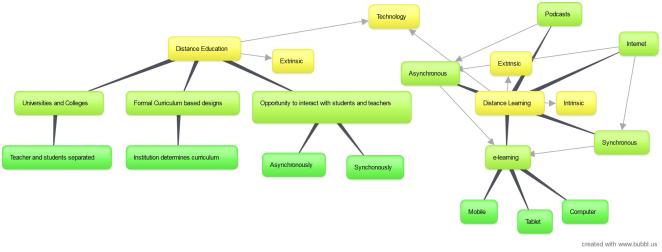
Distance Learning and Distance Education – Are they the same?New-Mind-Map(1)

Distance learning has been around for a long time. It’s easy to associate it primarily with online programs associated with Universities and Colleges. I took my first distance learning course when I filled out the back of a matchbook to learn how to write children’s books back in the 1970’s via a correspondence course. I cannot recall if that course was associated with any type of a learning institution. I see distance learning as learning that doesn’t happen face-to-face, in a traditional classroom.  This type of learning can be either synchronous or asynchronous (Simonson, Smaldino, & Zvacek, 2015, pgs. 175-176). My definition incorporates many things from watching a YouTube video on how to properly paint a wall to taking an online program in preparation to be certified in CPR (cardiopulmonary resuscitation).

Diving into the history and examples of distance learning initially created a more limited definition stating that distance education contained four components which include (Simonson, et al, 2015, pgs. 31-33):

  • Institutionally based
  • Learning communities
  • Interactive telecommunications
  • Teacher and students are separated

This highlights the interchangeability in terms between distance education and distance learning; but are they interchangeable? The above definition centers solely around the learning institution – therefore, distance education. Distance learning can encompass a much broader definition which to some may be called self-study (Simonson, et al, 2015, Pg. 56). The correspondence course I took in the 1970’s was self-study and under this definition, would not have qualified as distance education and yet correspondence courses were some of the earlier forms of distance education. This comes down to extrinsic and intrinsic motivation (Holman, 2014).

This definition also ignores learning that takes place daily in companies and institutions. While terms like e-learning and virtual training may not be considered distance education (Simonson, et al, 2015), they still encompass learning at a distance, whether delivered synchronously or asynchronously.

The future of distance learning is great. With each new improvement and enhancement of technology, new opportunities arise for the distance learner. The ability to conduct research at home, interact with a learning community in real time and turn in papers virtually has changed the world of learning for the better. I look forward to seeing what the future brings and I can’t wait to be one of the early adopters.


References

Holman, M. (2014, August 06). Education vs Learning – What Exactly is the Difference? Retrieved from http://edtechreview.in/trends-insights/insights/1417-education-vs-learning-what-exactly-is-the-difference

Moller, L., Foshay, W., & Huett, J. (2008). The evolution of distance education: Implications for instructional design on the potential of the web (Part 1: Training and development). TechTrends, 52(3), 7075.

Moller, L., Foshay, W., & Huett, J. (2008). The evolution of distance education: Implications for instructional design on the potential of the web (Part 2: Higher education). TechTrends, 52(4), 66–70.

Huett, J., Moller, L., Foshay, W., & Coleman, C. (2008). The evolution of distance education: Implications for instructional design on the potential of the web (Part 3: K12). TechTrends, 52(5), 636 7.

Simonson, M., Smaldino, S., & Zvacek, S. (2015). Teaching and learning at a distance: Foundations of distance education. Charlotte, NC: Information Age Publishing.


Then and Now

The following is my exploration, through questions and answers of my learning progression throughout the Learning Theories Instruction course at Walden University.

Q: Now that you have a deeper understanding of the different learning theories and learning styles, how has your view on how you learn changed?

A: I have now completed week 7. The very first discussion we had, week 1, asked us to reflect on how we best learn and the theories we are most aligned with. My answer still stands as is but, I would add to it. During this discussion I stated that:

My preferred theoretical approach to learning is constructivism. I enjoy creating my own links and mental models rather than having them fed to me through the instructional process. I thoroughly enjoy linking my past experiences, both good and bad, to my newly learned skills. Transfer for me happens by practicing authentic, real world tasks, not hypothetical, role-playing tasks. I firmly believe that the more complex the skills being taught, the more the learner’s context shapes what they assimilate and what they reject within the learning.

What I would add to this statement, after further study and research, is how important the role of the learner is in shaping their learning. I think I knew that before, but didn’t see the magnitude of that for adult learners. The adult learner is in full control of what they chose to take in, assimilate, agree with and reject. During facilitated learning this is critical that the instructor understands this and works to relay the “what’s in it for me” for the learners. Flexibility is essential for the adult learner.

Q: What have you learned about the various learning theories and learning styles over the past weeks that can further explain your own personal learning preferences?

A: Delving into behaviorism was interesting because I found it to be narrow focused and more teacher centric. When I have had an instructor use more of the techniques in behaviorism, I am more frustrated, bored, and insulted. This theory seems more suited for children and less for adults. I do understand that repetition of behavior allows the learner to create patterns that are repeatable, but it is not my preferred method of learning.

  • I align with the adult learning principles that Malcolm Knowles created:
  • I am autonomous and self-directed
  • I love being encouraged to bring my knowledge and experience into new learning situations.
  • I want the learning to be relevant – this is a little more flexible for me – relevance can simply relate to an interest in the subject, not solely on whether or not it’s usable.

Q: What role does technology play in your learning?

A: Having grown up with little to no technology and now using it every day, allows me a unique perspective over younger learners. I grew up with Encyclopedia Britannica Encyclopedia Brittanica and now I have Wikipedia and the entire internet at my fingertips. This has changed learning as we know it. More information is available than ever before. Instructors can’t make inaccurate declarative statements in class without a student contradicting their information. Learning is happening more frequently and casually than ever before. The ability to look something up on a smart phone, to research which actor was in what movie, and to watch a YouTube video to learn how to play the guitar or paint a wall allows learning to happen rapidly and constantly. Webinars can be viewed on a cell phone. Workers can review critical procedures, just-in-time while out in the field. 3D printers allow surgeons to conduct complex, one of a kind procedures with more assurance. I am able to freely publish a blog. The possibilities are endless. I am learning all the time because of technology and I love it.

Connectivism – the Web of Learning

New-Mind-Map_4t4u2dgw

Like a caricature of a real person, this image looks like a web of the way I learn and it only cracks the surface. I started getting into the weeds on this one. Should I name my favorite research papers? Do I list all the techniques I have experienced with experiential learning?

I am 51 years old. I grew up with Encyclopedia Britannica and a party line. I sat in rows in school, facing the front where the teacher lectured. I watched 3 channels on our black and white television. I knew the Dewey Decimal System – it was my friend. Learning looks a lot different now.

The internet has changed everything. The ability to access it not only at home or work, but everywhere has completely put an end to the bets I used to place with my brother during dinner. Bets that were often hard to prove for certain without a lot of effort and verification. Now, a teacher or trainer cannot state anything as fact if they are not certain because their students can and often will contradict them by quickly looking it up on their laptop or cell phone.

Books and Magazines are still the hold out for me. I prefer to have the “hard copy” whenever possible. I have often read a book, especially non-fiction, and later bought the hard copy because I wanted to touch it, to underline the words, dog-ear pages, to bring it into my classroom.

Questions I have can still be answered the old fashioned way by asking more knowledgeable people. I also use the internet and websites to verify accuracy, like Snopes.com or sites I know are reputable.  I have learned the hard way by posting something on social media that turned out to be completely false.

So how does all this relate to connectivism?

According to Siemens, “connectivism is driven by the understanding that decisions are based on rapidly altering foundations. New information is continually being acquired and the ability to draw distinctions between important and unimportant information is vital. Also critical is the ability to recognize when new information alters the landscape based on decisions made yesterday” (Siemens, 2005, para. 24).

This sums up what I would call Internet Age Learning. We are learning faster and able to be more nimble than ever before. Technology allows us to collect more data, make smarter decisions and publish new findings immediately. This allows us to learn rapidly, unlearn equally as quickly and pass it on. This sums up the main way I learn outside of traditional learning. What’s not to love?

Siemens, G. (2005, January). Connectivism: A learning theory for the digital age. International Journal of Instructional Technology & Distance Learning, Retrieved November 03, 2008, from http://www.itdl.org/Journal/Jan_05/article01.htm

Brain Learning Resources

Brain-610x250

As a public speaker, facilitator and instructional designer, I am constantly tweaking my presentations and designs, on-the-fly to enhance my learners experience. I read John Medina’s book Brain Rules several years ago and recently found his blog. His most recent blog Brain Rules for Presenters contains great reminders and insights on how to capture your audience (and their brains) attention.

His writing is clear, light-hearted and gets to the point quickly. He talks about how our brain assesses new incoming information with 6 questions. The last two being: Have I seen it before? Or, have I never seen it before? This is important because the brain is a master at pattern matching. As an instructional designer, knowing that your learners are looking for patterns aligns with adult learning principles – especially in how adults want to link what they are learning to previous experience.

If you haven’t read John Medina’s book, Brain Rules, I highly recommend it. His blog touches on some of his newer work and illustrates the main rules of how to get the most out of your brain. Here is a quote from his blog – Brain Rules for Meetings that sums up his style and his work:

Not that Brain Rules will tell you how the brain operates. “We don’t know squat about how the brain works,” said Medina, who has focused on brain research for nearly three decades. He added: “I don’t know how you know how to pick up a glass of water and drink it. But we do know the conditions that [the brain] operates best in, even if we don’t know all the ins and outs of that operation.”

Another resource I find interesting is the article, “What You Should Know About Your Brain“, by Judy Willis. I love this article because it clearly covers the science of the brain and what each area is responsible for and then it dives into what the learner should do to enhance awareness and improve the performance of their brain. Here’s an example she covers in her section titled, What You Can Do in regard to The Amygdala:

“Another technique that helps you choose what to do with your emotions—something only humans can do— is to imagine you’re directing yourself in a play. You are the director sitting in a balcony seat watching an actor (the emotional you) on stage below. What advice would you give the emotion-filled actor on the stage if he or she had been pushed by a classmate and wanted to hit back, for example? This technique helps you move away from using your reactive brain and tap your thinking brain, where memories that might help you are stored”.

I am a fan of practical advice linked to scientific research. Even though this is written for younger students, this work easily can be translated to adult learners. I have seen many adult learners triggered by their Amygdala during a workshop in a business setting. The challenge for the instructional designer is incorporating some of these tips into the design to facilitate the best possible learning environment.

“How to Teach Students About the Brain,” by Judy Willis, Educational Leadership, 67(4). Copyright © 2009 ASCD.