Distance Learning and Distance Education – Are they the same?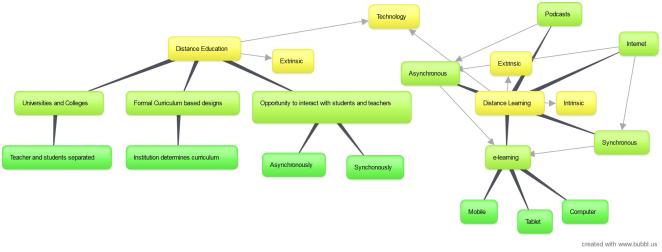
Distance learning has been around for a long time. It’s easy to associate it primarily with online programs associated with Universities and Colleges. I took my first distance learning course when I filled out the back of a matchbook to learn how to write children’s books back in the 1970’s via a correspondence course. I cannot recall if that course was associated with any type of a learning institution. I see distance learning as learning that doesn’t happen face-to-face, in a traditional classroom. This type of learning can be either synchronous or asynchronous (Simonson, Smaldino, & Zvacek, 2015, pgs. 175-176). My definition incorporates many things from watching a YouTube video on how to properly paint a wall to taking an online program in preparation to be certified in CPR (cardiopulmonary resuscitation).
Diving into the history and examples of distance learning initially created a more limited definition stating that distance education contained four components which include (Simonson, et al, 2015, pgs. 31-33):
- Institutionally based
- Learning communities
- Interactive telecommunications
- Teacher and students are separated
This highlights the interchangeability in terms between distance education and distance learning; but are they interchangeable? The above definition centers solely around the learning institution – therefore, distance education. Distance learning can encompass a much broader definition which to some may be called self-study (Simonson, et al, 2015, Pg. 56). The correspondence course I took in the 1970’s was self-study and under this definition, would not have qualified as distance education and yet correspondence courses were some of the earlier forms of distance education. This comes down to extrinsic and intrinsic motivation (Holman, 2014).
This definition also ignores learning that takes place daily in companies and institutions. While terms like e-learning and virtual training may not be considered distance education (Simonson, et al, 2015), they still encompass learning at a distance, whether delivered synchronously or asynchronously.
The future of distance learning is great. With each new improvement and enhancement of technology, new opportunities arise for the distance learner. The ability to conduct research at home, interact with a learning community in real time and turn in papers virtually has changed the world of learning for the better. I look forward to seeing what the future brings and I can’t wait to be one of the early adopters.
References
Holman, M. (2014, August 06). Education vs Learning – What Exactly is the Difference? Retrieved from http://edtechreview.in/trends-insights/insights/1417-education-vs-learning-what-exactly-is-the-difference
Moller, L., Foshay, W., & Huett, J. (2008). The evolution of distance education: Implications for instructional design on the potential of the web (Part 1: Training and development). TechTrends, 52(3), 7075.
Moller, L., Foshay, W., & Huett, J. (2008). The evolution of distance education: Implications for instructional design on the potential of the web (Part 2: Higher education). TechTrends, 52(4), 66–70.
Huett, J., Moller, L., Foshay, W., & Coleman, C. (2008). The evolution of distance education: Implications for instructional design on the potential of the web (Part 3: K12). TechTrends, 52(5), 636 7.
Simonson, M., Smaldino, S., & Zvacek, S. (2015). Teaching and learning at a distance: Foundations of distance education. Charlotte, NC: Information Age Publishing.
 Aimee Windmiller-Wood - ePortfolio